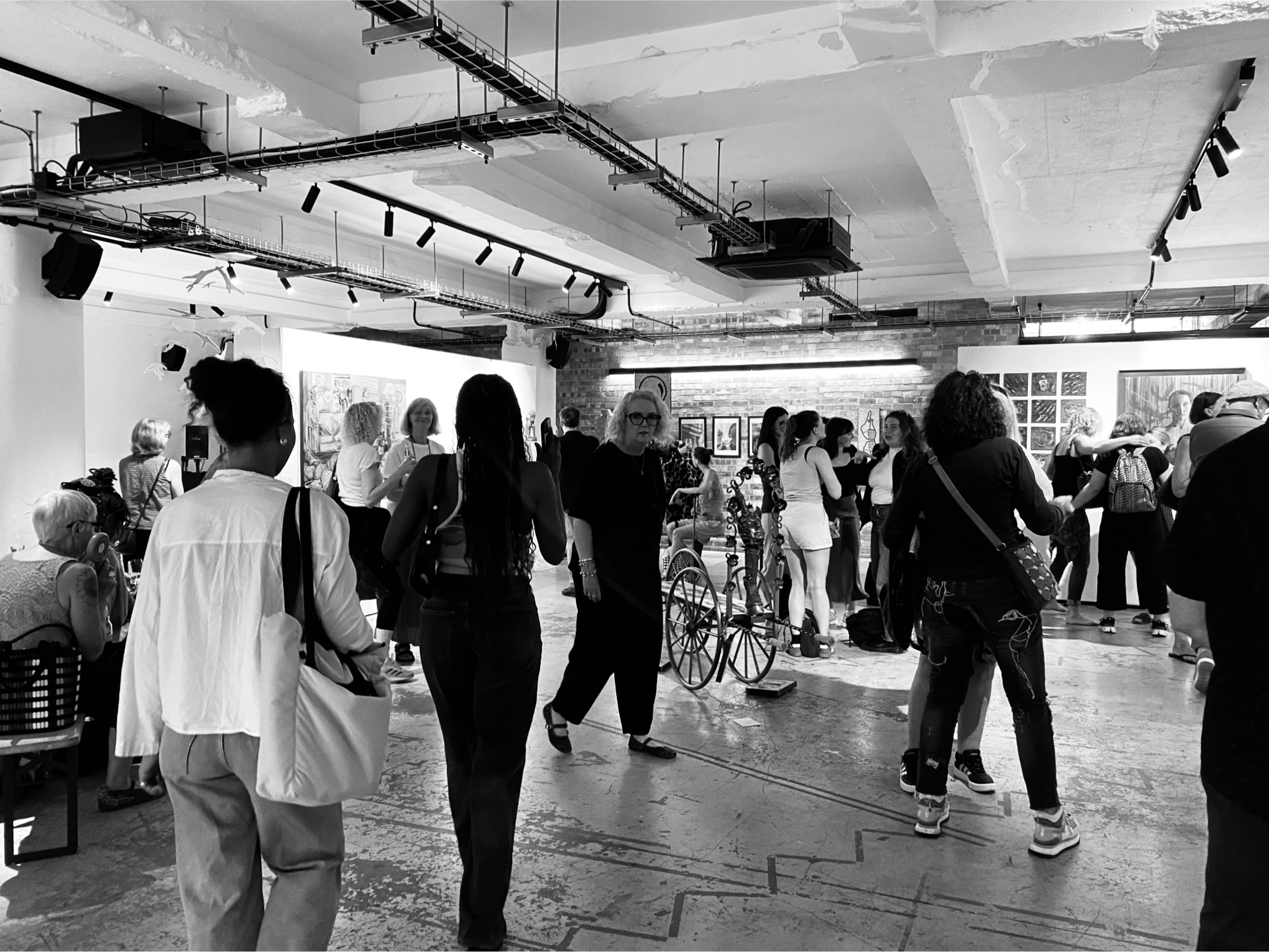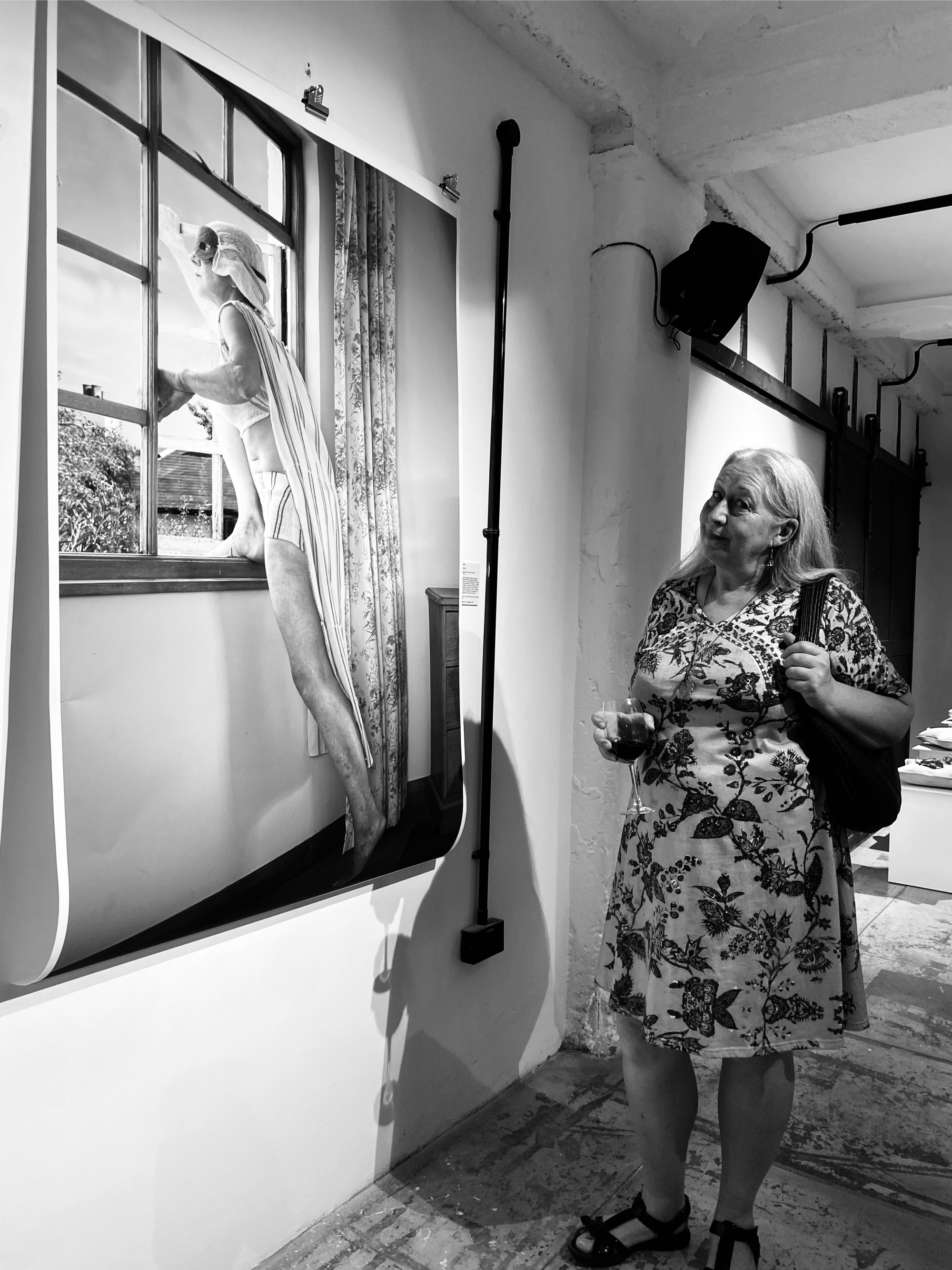
By the time the DJ started, The Department Store was full to the edges. Not the polite, circulating fullness of a standard private view, but the warm, noisy fullness of a room where people actually want to be in it. The space helped. The downstairs of The Department Store is not a white cube: it's a Victorian industrial interior with exposed brickwork and peeling plasterwork and a sense of physical history that the exhibition used rather than fought against. Araba Ocran's curatorial instinct was to meet the building where it was.
Gritted Teeth is a show about endurance. Its subtitle — an art exhibition by women, for everyone to enjoy — is exactly what it says. Twenty-four female artists, spanning ages from their twenties to their seventies, exploring what it costs to hold composure: the bras that dig in, the heels that hurt, the performance that gets demanded so persistently it eventually becomes habit. The work lives, as the press material puts it, in the tense space between grace and discomfort.
The first thing you see when you come down the stairs is the robot: a near-life-size female figure in silver and red, assembled from what appear to be car panels and industrial components. She is mid-stride, one leg raised, both hands reaching — not in supplication but in something between assertion and negotiation. She is beautiful in the way that armour is beautiful. She drew a crowd all evening. Full credits for this piece are still to be confirmed.
Sarah Muwanga's large acrylic painting of a domestic interior — six figures in amber and teal and orange, arranged around a room with a bookcase and a low couch and that specifically tired quality of a family gathering — stopped people cold. It is very large, and very warm, and completely unsentimental. The figures are absorbed in themselves: one kneeling on the floor, one leaning over a sofa, a child reading. The light across it is the light of late afternoon in a room where nothing is wrong exactly, but everything is heavy.
In the same room, Birgitta Hosea's Scoured I–XVI covered most of a white panel: sixteen small dark canvases arranged in a four-by-four grid, each one the result of a metal pan scrubber worked with bleach through layers of inked paper. The marks they leave are not quite holes and not quite gestures — they are the preserved traces of repetitive cleaning, the invisible labour made stubbornly visible. Created in snatched moments between hospital visits and phone calls with care workers, the piece has a companion: Darned I–XVI, made in 2026, in which the fragile, scoured surfaces are stitched back together again. Together they are a complete sentence.
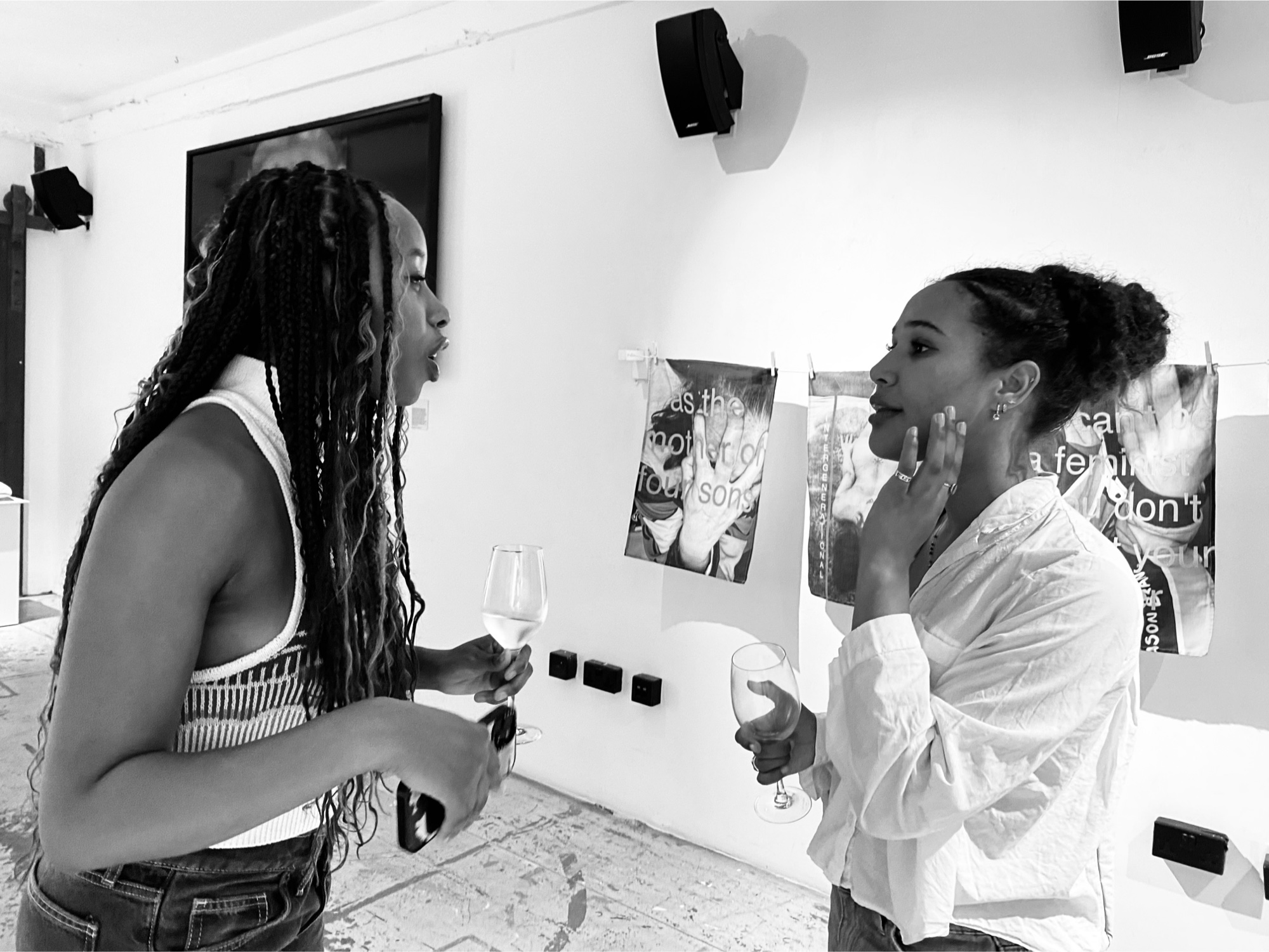
Nonika Hendrickse Vagliviello's three tea towels hung on a washing line strung between two fixings on a white wall: as the mother of four sons, INTERGENERATIONAL EXHAUSTION (the figure inverted, legs in the air, arrows going in opposite directions), you can't be a feminist if you don't respect your mother. The medium is deliberate — cotton tea towels are the form of domestic gift-giving, the thing you buy someone to acknowledge their kitchen labour — and the photographs printed on them are iPhone selfies. Her label text, which deserves to be quoted directly rather than paraphrased, describes her "guttural rejection of forced terminology such as 'birthing person', 'chestfeeding' and 'cervix haver'." The work is funny and furious in equal measure, and the three pieces on the line had people reading and then re-reading and then reading aloud to each other.
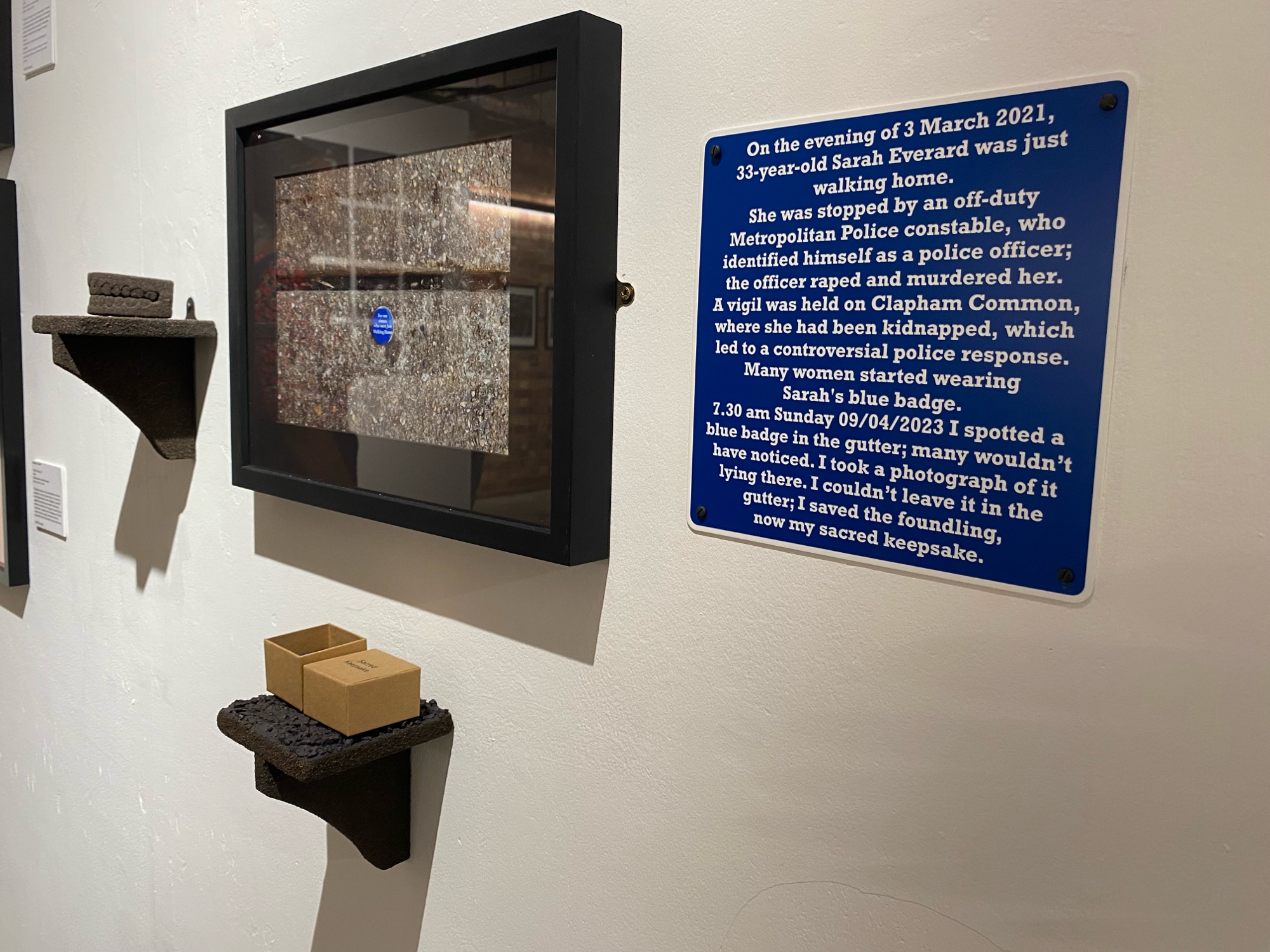
Linda Hubbard's piece was smaller and quieter and possibly the most devastating. A photograph of a gutter, a blue plaque on the wall beside it, a keepsake box on a small shelf below. The plaque explains: on the evening of 3 March 2021, Sarah Everard was just walking home. On Sunday 9 April 2023, Hubbard found a blue badge — the kind women had been wearing in Sarah's memory — lying in a gutter. She couldn't leave it there. It became a sacred keepsake. The photograph documents where the badge was. The piece is called Happenstance Urban Still Lifes: Another Blue Plaque — for our sisters who were just walking home.
Katie Surridge's Roman-style marble mosaics ran along the brick wall of the main space: tall, stark, figurative panels with titles drawn from catcalls — Burn Your Bra, Is this the Stairway to Heaven?, Your Eyes Are Like IKEA... I Could Get Lost In Them. The technique, ancient and painstaking, applied to the throwaway language of street harassment, produces a particular kind of unease. The mosaics looked like they had been there for centuries. They looked like they would still be there in centuries more.
Ellie Laycock's WIFEY — the cover artwork for her debut single as Eleanor Else — showed a hand gripping a steaming iron, the fingers adorned with a gold ring spelling out the word. It is the most immediately legible piece in the show and the one that photographs cleanly, which is not why it's good. It's good because the image is doing several things at once: the iron is domestic labour, the ring is ownership, the steam is heat and effort and the possibility of burning, and the hand is steady.
Anne Tilby's Tortured Soles Collection occupied its own small corner. The spiked, fur-covered forms of Killer Heels looked from a distance like sea creatures — urchins or anemones, soft and dangerous — until you got close enough to see the shoe inside. Control put a man's brogue and a woman's stiletto together into a single fused object: attached, literally. Tortured Soles, the red platform shoes, stared down from the wall with the cheerful brutality of a prop from a film no one would enjoy watching.
Nina Robinson's textile piece Who Gets To Be Known, And Who Does The Knowing? hung from a brass rail: a dark ground scattered with a grid of small coloured fabric squares in every material and texture imaginable — glitter and matte, silk and card — connected by threads and scattered with beads. The handwritten question above it is the work's engine. The piece considers the uneven distribution of curiosity in conversation: who is treated as interesting by default, and who has to earn it.
Ingrid Barber's ceramic torsos lined two shelves and occupied a plinth: glazed figures with painted words on their chests — No Way!!, BASTARDO!, miaow, Hell Yes, Purr..., gritted teeth — and wild animals rendered in the glaze below, boars and cats and something between the two. They are funny and they are not subtle and they are very good.
And then there were the corsets. Araba Ocran's own work: two black mannequin torsos wearing constructions of wire, beading, chain and found materials — one presented within a perspex case, one freestanding on a tall tripod stand. The corset as historical instrument of female bodily control, returned to the woman wearing it, transformed into something elaborate, defiant, self-possessed. One of the private view's particular pleasures was watching people clock that the curator was also an artist, and that her pieces were the most architecturally complex things in the room.
The DJ played vinyl. The conversation was loud. By the end of the evening, with the lights up and the last stragglers reluctant to leave, the show had done what the best shows do: it had made the works feel necessary, and the room feel like a place where something had happened.
Gritted Teeth runs at The Department Store, 248 Ferndale Road, Brixton, SW9 8FR until Sunday 31st May 2026. Free admission.
Full artist credits and individual artist pages are being added to this site — check back soon. Credits for several works shown at the private view are still being confirmed; updates will follow.